Scaling Your Health Practice
Oct 15, 2026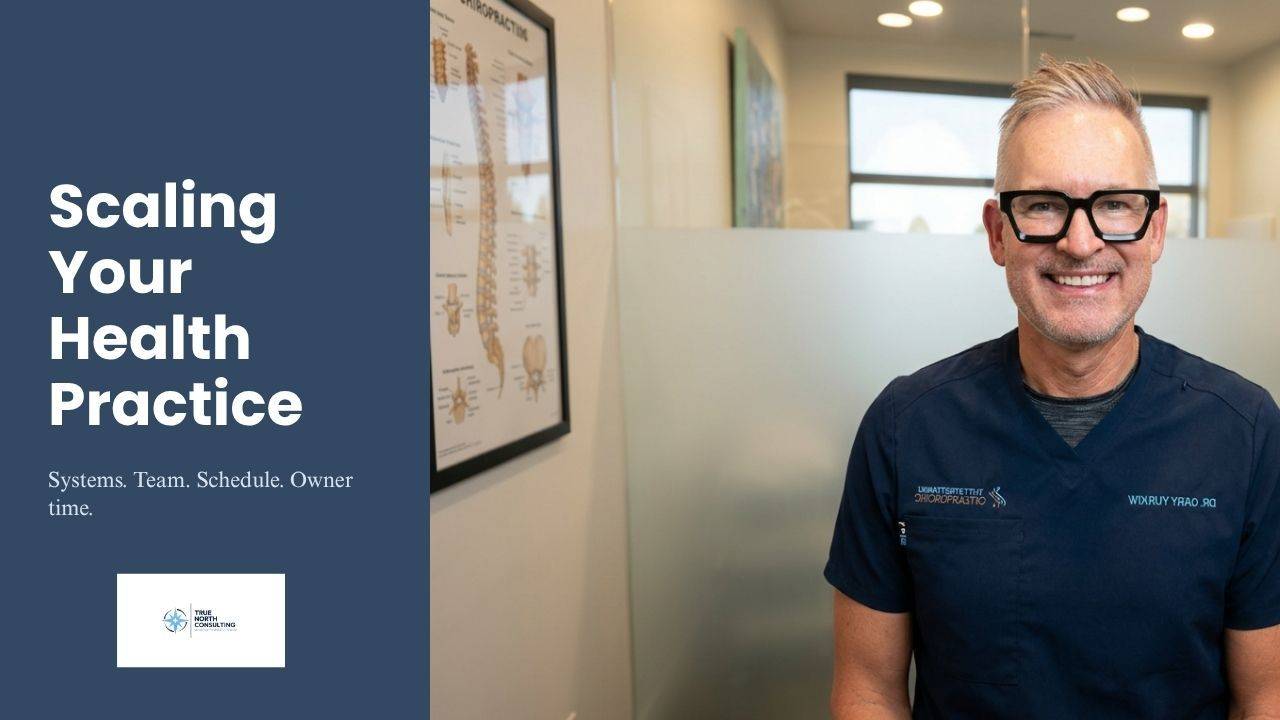
Growth isn't more hours from you. It's systems, a team and a schedule that carry the load.
It's 7:40 on a Tuesday night. The last patient left an hour ago. You're still at the front desk, fixing tomorrow's schedule, answering a team question by text, and wondering why a clinic that looks busy on paper still feels like it runs on you.
If that sounds familiar, you're not doing it wrong. You've just reached the point every growing practice reaches: the way you built the clinic isn't the way it will grow.
I'm Dr. Cary Yurkiw. I've been in practice for 33 years, 25 of them as a clinic owner at Tutt Street Family Chiropractic here in Kelowna, and I still treat. Through True North Practice Management I've worked inside more than 80 clinics. The owners who scale well aren't the ones who work the most hours. They're the ones who stop being the system.
Here's how I'd think about it, in four parts.
1. Systems: get it out of your head and onto paper
Most clinics run on memory. The owner knows how a new patient should be welcomed, how a missed appointment gets followed up, how a plan of care is explained. The team knows some of it. Nobody has written it down.
That works with one doctor and one front desk person. It stops working the day you add a second provider or a new hire.
Start small. Pick the five moments that happen every single day:
- The first phone call or online booking
- The new patient's first visit, start to finish
- The end of every visit, when the next step gets booked
- A missed or cancelled appointment
- The end-of-day close
For each one, write a one-page checklist. Plain language. Who does what, in what order, with what words. Don't aim for perfect. Aim for written, then improve it every month.
I've written before about the dropout problem, where good care never becomes a plan because nobody owns the last thirty seconds of the visit. A written end-of-visit system is often the first place I'd look.
2. Team: hire for ownership, not just tasks
When owners feel stretched, the first instinct is to hire. Sometimes that's right. Often the bigger shift is giving the team you already have clear ownership.
There's a difference between "help at the front desk" and "you own the schedule." The first person waits for instructions. The second person notices the gap on Thursday afternoon and fills it.
A few practical steps:
- One owner per outcome. Who owns rebooking? Who owns reactivation calls? Who owns the new-patient experience? One name for each, not "everyone."
- A short weekly huddle. Fifteen minutes. Look at the week ahead, the gaps, and one thing to improve. Same day, same time.
- Train to the checklist. Your written systems become the training manual. New hires learn the clinic, not just your habits.
- Let them solve it. When someone brings you a problem, ask what they'd suggest first. You'll be surprised how often they already know.
Your job shifts from doing everything to making sure everything has an owner.
3. Schedule: design it on purpose
Most schedules aren't designed. They accumulate. A patient asks for 4:45, so 4:45 opens up. New patients get squeezed in wherever there's room. Before long, the day has no shape and you're running behind by ten in the morning.
Try building your ideal week on paper first:
- Block new patient times at the points in the day when you have the most energy and attention.
- Group similar visits so you and your team can find a rhythm.
- Protect a buffer in the morning and afternoon for the things that always come up.
- Decide your hours and let the schedule fit inside them, not the other way around.
Then hand the ideal week to whoever owns the schedule and let them fill it. Review it together once a month. Where did it drift? Why? What needs to change?
A designed schedule makes it easier to add a provider later, because you already know what a good day looks like.
4. Owner time: protect the hours that grow the clinic
This is the one most owners skip, and it matters most.
If every hour of your week is spent treating or putting out fires, there's no time left to lead. Nobody is reviewing the numbers, coaching the team, improving the systems or planning the next step. The clinic stays the same size because the owner has no room to grow it.
So put it in the calendar like an appointment:
- A weekly CEO block. Two to three hours, same time each week, door closed. Review your key numbers, check on your systems, plan the week.
- A monthly team review. One meeting to look at what's working and what isn't.
- A quarterly look ahead. Where do you want the clinic to be in a year? What has to be true by then?
Treat these blocks with the same respect you give a patient. If you wouldn't cancel on a patient for a phone call, don't cancel on your clinic either.
Where to start this week
Don't try to fix all four at once. Pick one:
- Write the checklist for the end of a visit.
- Name one owner for rebooking.
- Draw your ideal week on a single sheet of paper.
- Book your first CEO block for next week.
Do one well, then add the next. Steady, written, repeated. That's how a practice grows without swallowing the person who built it.
Let's talk about your clinic
Every clinic is a little different. Your team, your town, your patients and your goals all shape what the next step looks like. If you'd like a second set of eyes on your systems, team, schedule or owner time, I'd be glad to talk it through with you.
Book a consult with me at linktr.ee/truenorthpm.
Dr. Cary Yurkiw
True North Practice Management
Ready to achieve your personal and professional goals? Contact us today to book your free consultation and start your journey!
Stay connected with news and updates!
Join our mailing list to receive the latest news and updates from our team.
Don't worry, your information will not be shared.
We hate SPAM. We will never sell your information, for any reason.
